When it comes to feeding a Mastiff puppy, one thing matters most to me: allowing healthy growth – not trying to make a puppy grow as big as possible, as quickly as possible.
An English Mastiff will eventually become a very large and heavy dog. That is exactly why the body needs time. Bones, joints, muscles and the entire musculoskeletal system continue developing for many months. A puppy that gains weight particularly quickly is therefore not automatically a puppy that is being especially well fed.
For me, good Mastiff puppy nutrition is based on three things: a suitable and balanced diet, an amount of food that matches the individual puppy, and regularly looking at how that puppy is actually developing.
We have already looked in more detail at how differently Mastiffs can develop during this period in our article about Mastiff puppy growth.

How should you feed a Mastiff puppy?
A Mastiff puppy should receive a complete food formulated for growing large or giant-breed dogs and should grow in a lean, steady way.
That sounds simple at first. In everyday life, however, a young Mastiff’s weight, body shape, activity level and appetite can change considerably within only a few weeks. I therefore do not rely solely on the number printed on a bag of food. The manufacturer’s feeding recommendation is a sensible starting point – but it is not an unchangeable rule.
Two Mastiff puppies of the same age may need different amounts of food. Activity, metabolism, developmental stage, body type and the energy density of the food all play a part. For me, the individual dog standing in front of me is always important as well.
How much food does a Mastiff puppy need each day?
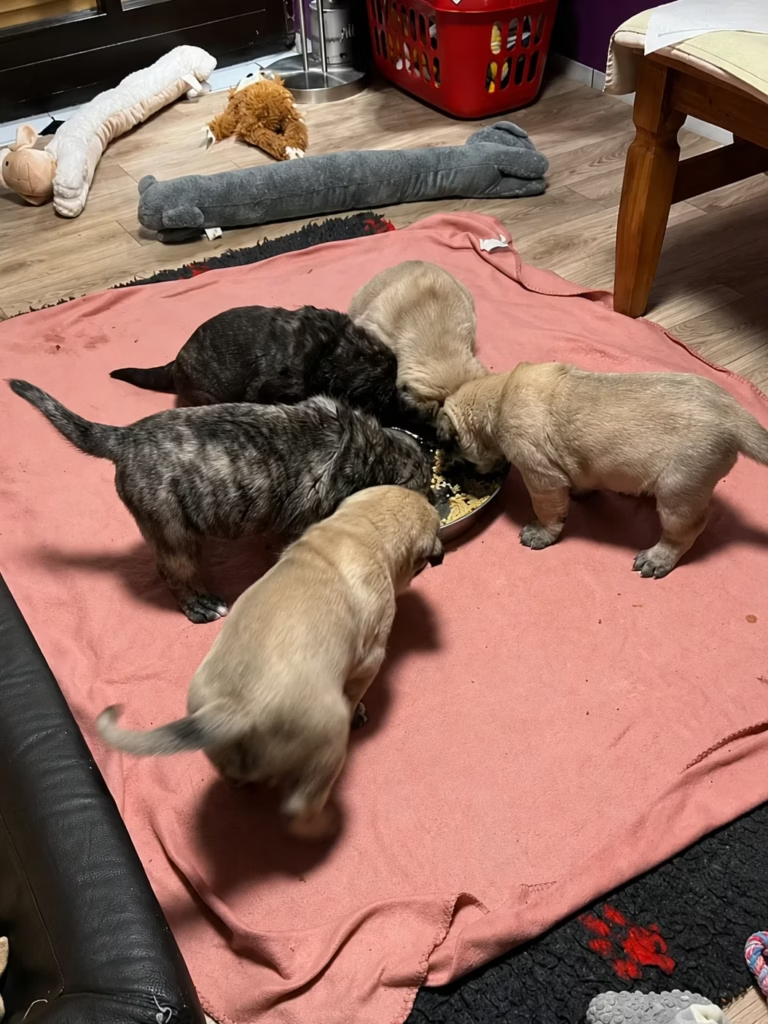
I do not think there is one sensible number of grams that applies to every Mastiff puppy. The correct amount depends on the puppy’s age and weight, the energy density of the food, activity level, individual metabolism and current stage of growth. Treats and chews also contribute to the daily energy intake.
That is why I would never say, “Every three-month-old Mastiff puppy needs exactly X grams.” I start with the manufacturer’s recommendation and then watch the puppy. If the puppy becomes visibly too round, the amount is adjusted. If the puppy appears unusually thin over a longer period or begins losing weight, that also deserves a closer look.
Especially with giant breeds, more food is not automatically better. A consistently excessive energy intake can encourage unnecessarily rapid growth. Controlled energy intake and steady development are therefore particularly important in large and giant-breed puppies.
How quickly should a Mastiff puppy grow?
As steadily as possible – without trying to turn a young dog into an especially heavy Mastiff at an early age.
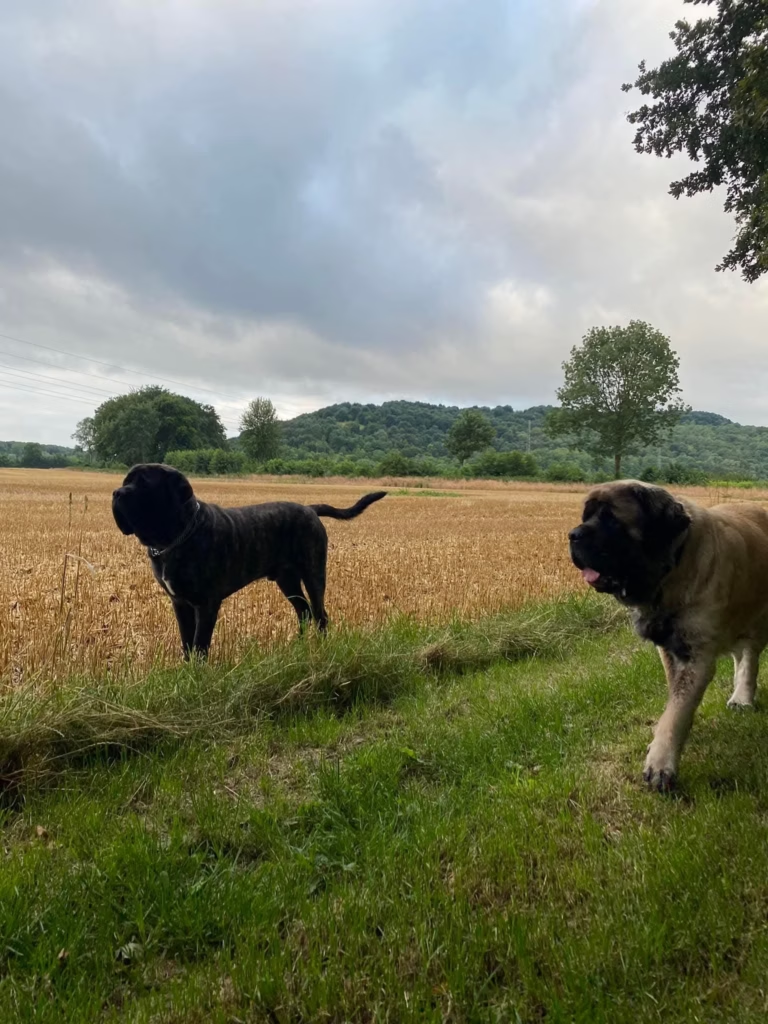
Mastiffs do not grow according to a perfect chart. There are stages when the legs seem to become longer almost overnight. Then the chest becomes broader, the head changes or the entire dog suddenly looks more balanced again. Some puppies develop very evenly, while others go through much more noticeable growth spurts.
For that reason, I do not see much value in constantly comparing your own puppy’s weight with other Mastiffs of the same age. A growth chart can provide some orientation, but it can never replace looking at the individual dog. What matters much more to me is: What does the puppy look like? How does the puppy move? And how is the puppy developing over several weeks?
Exercise and growth are closely connected as well. We explain in more detail what we consider appropriate for a young Mastiff in our guide to exercise during puppyhood.
What is the best food for a Mastiff puppy?
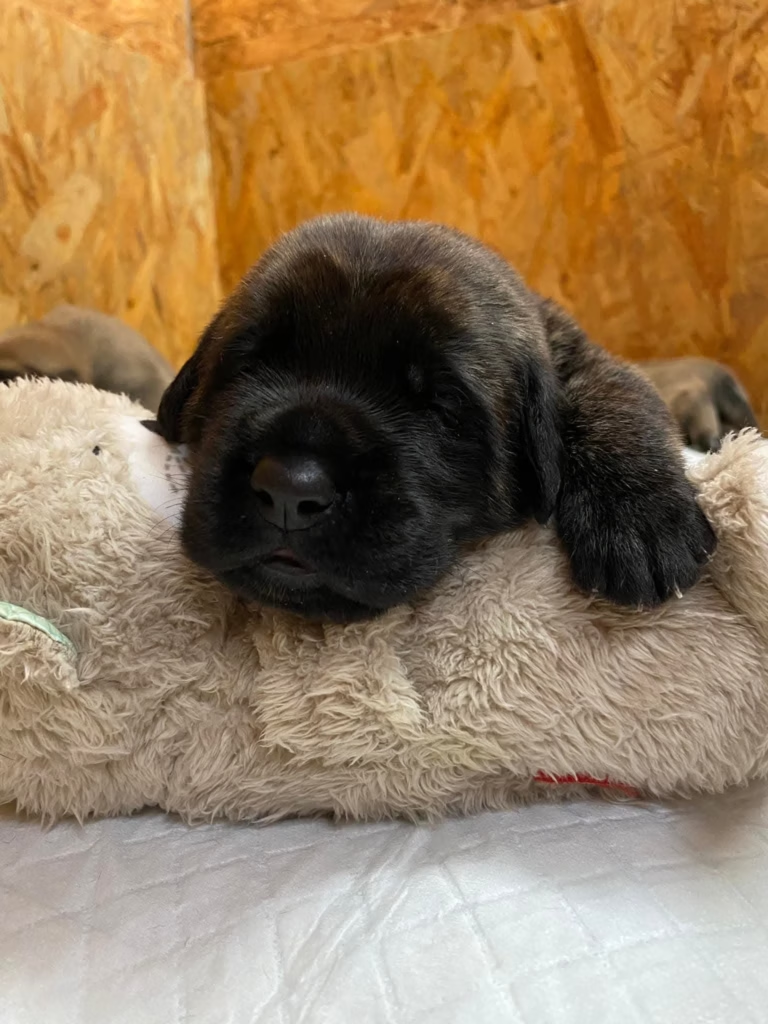
I would choose a complete food formulated for growth and, ideally, specifically for large or giant breeds.
For me, the important question is not whether the packaging lists as many impressive-sounding ingredients as possible. What matters more is whether the overall diet is balanced and meets the nutritional requirements of a growing dog.
For a young Mastiff, appropriate energy intake, sufficient high-quality protein and a controlled supply of calcium, phosphorus, vitamins and trace elements are particularly important. A good puppy food is a complete nutritional concept. Individual figures should therefore not be viewed entirely in isolation.
An important European reference is provided by the FEDIAF Nutritional Guidelines, which include recommendations for nutrient provision during different life stages.
Is too much protein harmful for Mastiff puppies?
Protein is essential for a growing dog. The frequently repeated claim that “too much protein makes large dogs grow too quickly” is therefore too simplistic.
Puppies need protein for their muscles, organs, skin and numerous metabolic processes. Rather than trying to keep the protein level as low as possible, the more important consideration is whether the entire diet is balanced. Energy intake and mineral supply need to suit the puppy’s growth.
I would therefore not choose a puppy food simply according to which bag has the lowest or highest protein percentage. What matters is whether the complete food has been formulated sensibly for the growth phase of a giant breed.
Does a Mastiff puppy need additional calcium?
With a balanced complete puppy food, normally no.
Especially with giant-breed puppies, I think the idea of adding extra calcium “just to be safe for the bones” can be problematic. Calcium is, of course, essential for skeletal development. But excessive calcium intake during growth is undesirable as well.
If the food is complete and formulated for growing large dogs, I would therefore not add mineral or vitamin supplements unless there is a specific veterinary reason to do so.

Dry food or wet food – which is better?
Both can work. The first question is not whether the food is dry or wet, but whether it is complete, balanced and suitable for growth.
Dry food is easy to portion in everyday life and usually has a higher energy density. Wet food contains considerably more water, so the amount in the bowl is correspondingly larger. A combination of the two can also work.
If different foods are combined, however, the total daily intake still matters. The same applies to chews, training treats and other extras.
Is a raw diet suitable for a Mastiff puppy?
A homemade raw diet can in principle be formulated to meet a puppy’s nutritional requirements. With a Mastiff puppy, however, I would be particularly careful.
The growth phase of a giant breed is not, in my opinion, the right time to feed by guesswork. Calcium, phosphorus, trace elements, vitamins and energy all need to be balanced properly.
The World Small Animal Veterinary Association (WSAVA) points to both possible nutritional imbalances and hygiene risks associated with raw animal products.
If someone wants to feed a Mastiff puppy a homemade cooked or raw diet, I would recommend having the ration formulated by a suitably qualified veterinary nutrition professional. I would not consider a random online raw-feeding calculator sufficient for a growing giant-breed puppy.
How often should you feed a Mastiff puppy?
Young puppies should have their daily food divided into several meals. After moving to their new home, three meals per day is a practical routine for many puppies. Very young puppies may previously have been fed four smaller meals.
As the puppy becomes older, this can gradually be reduced to two meals per day. The exact timing does not have to be identical for every dog.
I like fixed feeding times because they create structure and make it easier to see how much the puppy is actually eating. I do not find a permanently full food bowl particularly useful for a growing Mastiff.
How many treats can a Mastiff puppy have?
Small treats count towards the daily intake too. During puppyhood, they can add up surprisingly quickly: training, recall, loose-lead walking, rewarding calm behaviour or simply giving a small treat in between.
As a practical guideline, treats should make up only a small proportion of the total daily energy intake. The AAHA Nutrition and Weight Management Guidelines refer to the commonly used 10% rule.
If a lot of food rewards are used during training, part of the puppy’s normal dry-food ration can be used instead. That way, the puppy does not effectively receive another half-meal in treats on top of the normal daily ration.
Should a Mastiff puppy rest after eating?
I think a calm routine around mealtimes makes sense. A puppy does not need to race around the garden with other dogs, play wild tug games or run up and down stairs immediately after eating.
At the same time, there is no need to turn every meal into a complicated routine controlled by a stopwatch. Rest periods are an important part of everyday life with a Mastiff anyway. Feeding, exercise and recovery should simply fit together sensibly.
Especially during the first days in a new home, less is often more. A puppy is already processing countless new impressions.
When should a Mastiff change to adult food?
I would not switch a Mastiff to adult food early simply because the dog already looks impressively large.
Giant breeds take considerably longer to develop physically than small dogs. The appropriate time to change food depends on the particular product, the dog’s stage of development and the individual puppy, and for giant breeds it is often not until well into the second year of life.
I therefore do not find rigid rules such as “every Mastiff must change to adult food at twelve months” particularly useful. Further information on the special nutritional considerations for very large dogs can be found in the veterinary overview from VCA on large and giant-breed dogs.
How can you tell if a Mastiff puppy is overweight?
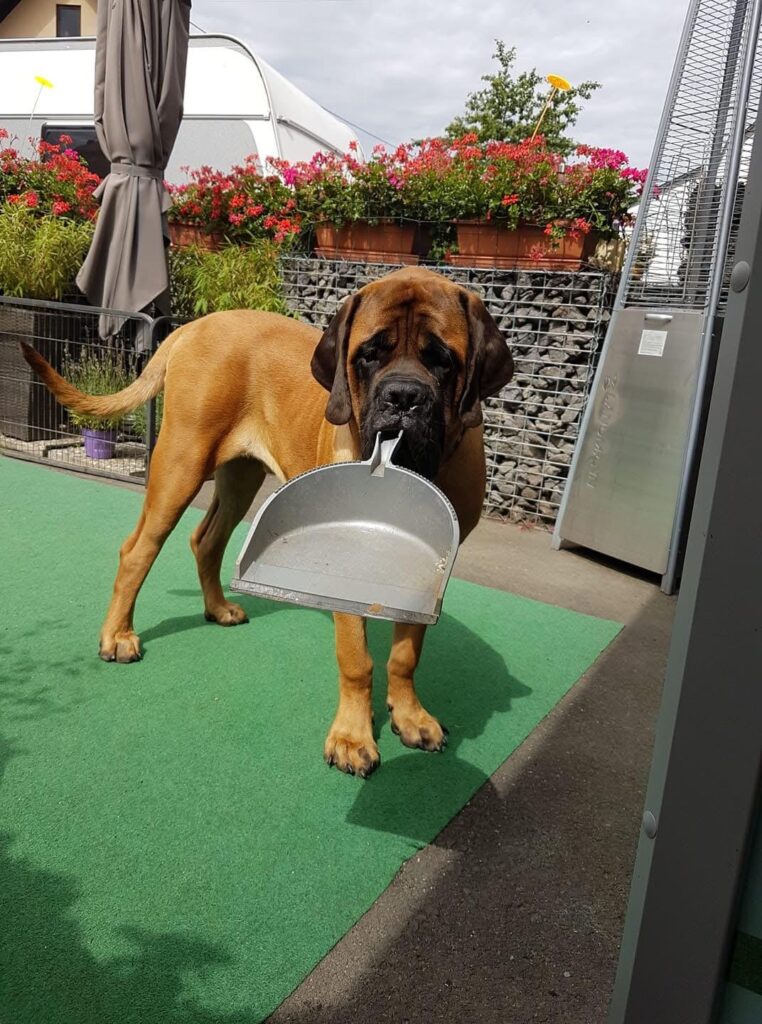
You should be able to feel the ribs easily without a thick layer of fat covering them. Viewed from above, a waist should also be visible.
A healthy Mastiff puppy does not need to look round and heavy. With this breed in particular, it is easy to assume that an especially massive puppy is automatically a better puppy. But a Mastiff naturally develops plenty of substance – there is no need to create it artificially through excess weight.
Using the Body Condition Score, a score of approximately 4 to 5 on a 9-point scale is generally considered ideal. The ribs should be easy to feel and a waist should be visible from above.
The scales are therefore only one tool. My hands and my eyes are at least as important.

When is a Mastiff puppy too thin?
A lean puppy is not automatically too thin. However, if the ribs, spine or pelvic bones become very prominent, the puppy loses weight, develops poorly or its appetite changes, it deserves a closer look.
Especially with sudden changes, I would not simply double the amount of food. Parasites, digestive problems, illness or other causes may also be involved. In such cases, the puppy should be examined by a veterinarian.
What feeding mistakes should you avoid with a Mastiff puppy?
Many mistakes are not caused by neglect, but by someone wanting to do something particularly good for their puppy. Problems can arise from consistently feeding too much, allowing unlimited access to food, adding unnecessary mineral supplements or giving large amounts of treats in addition to the normal daily ration.
- consistently feeding too much
- keeping the food bowl permanently full
- adding calcium without a specific need
- giving vitamin or mineral supplements without a clear reason
- giving large amounts of treats in addition to the normal daily ration
- frequently changing foods without a good reason
- feeding homemade diets without professional formulation
- constantly comparing the puppy with particularly heavy dogs of the same age
- wanting a young dog to become as massive as possible, as early as possible
A Mastiff will become big soon enough. But the dog only gets one growth period.
How should you change a Mastiff puppy to a different food?
If there is no medical reason for an immediate change, I would not replace the food completely from one day to the next.
A gradual transition over several days gives the digestive system time to adapt to the new food. The proportion of the new food can gradually be increased while the previous food is reduced accordingly.
I would also avoid changing everything immediately after the puppy moves into a new home unless there is a good reason. A new home, new people, unfamiliar sounds and a different daily routine are already a great deal for a young puppy to process.
Nutrition is only one part of healthy growth
Even the best food cannot replace a sensible everyday routine. Alongside appropriate nutrition, a Mastiff puppy needs enough sleep and rest, age-appropriate exercise, safe everyday experiences, social contact and, above all, time to mature both physically and mentally.
That is why our Mastiff puppies are not raised according to the fullest possible activity schedule. They should have the opportunity to experience new things, but they should also learn how to settle and rest.
We explain in more detail how we gradually prepare our puppies for life with their future families in our article about the socialisation of our Mastiff puppies.
My conclusion: a Mastiff does not need to grow as quickly as possible
A Mastiff will become large all by itself. There is no need to force the process.
For me, good nutrition during growth does not mean feeding as much as possible or adding as many supplements as possible. It means providing the body with the nutrients it needs while also giving it the time required for healthy development.
I would much rather see a Mastiff puppy grow lean, mobile and balanced than become especially heavy at an early age. I do not look only at grams and weight charts. I look at the whole dog: body condition, development, movement, appetite and general wellbeing.
Food, exercise, sleep, socialisation and a calm everyday routine all belong together for me.
Scientific background and further reading
The personal observations and experience in this article come from our everyday life with English Mastiffs. For the nutritional background, we also refer to recognised veterinary and nutritional sources.
FEDIAF – Nutritional Guidelines
European reference guidelines for nutrient requirements in dogs and cats at different life stages.
WSAVA – Global Nutrition Guidelines
International recommendations on nutritional assessment and food selection.
VCA – Nutritional Considerations for Large and Giant Breed Dogs
A veterinary overview of nutrition for large and giant-breed dogs during growth and adulthood.
AAHA – Nutrition and Weight Management Guidelines
Professional recommendations covering body condition, feeding amounts and weight management.
WSAVA – Raw Meat Based Diets for Pets
Information on potential nutritional and hygiene risks associated with raw feeding.
Would you like to learn more about our Mastiff puppies?
Appropriate nutrition is only one part of giving a puppy a good start. Careful rearing, thoughtful socialisation, sufficient rest, health and finding the puppy whose personality genuinely suits its future home are just as important to us.
- Puppies & Litter Planning
- Mastiff Puppy Growth
- How We Socialise Our Mastiff Puppies
- Is a Mastiff Suitable for a First-Time Owner?
Are you interested in an English Mastiff puppy, the way we raise our puppies or a future litter? Feel free to explore more of our website or get in touch with us personally.