When a Mastiff puppy curiously explores its surroundings, you naturally want to take it everywhere with you. Every new scent is exciting, a rustling leaf becomes a little adventure, and even a short walk just outside the front door can be full of new impressions.
At the same time, we know how quickly this small puppy will grow into a very large and heavy dog. That is exactly why we are asked the same question time and again:
How much exercise does a Mastiff puppy need – and when does it become too much?
In our view, there is no answer that can be expressed solely in minutes or kilometres. A puppy needs movement to develop muscles, coordination, balance and confidence in its own body. But it also needs people who pay close attention and recognise when a valuable experience is becoming too demanding.
For us, age-appropriate exercise therefore means above all:
A Mastiff puppy should be allowed to explore without already being expected to perform physically.
Exercise is part of healthy development
Out of concern for bones and joints, puppies of large breeds are sometimes protected particularly carefully. That concern is understandable – but it should not result in a young dog having hardly any opportunity to learn how to use its body.
A puppy should be allowed to walk, run, play, sniff and experience different surfaces. It can step over small obstacles, play with suitable dogs and sometimes still be a little clumsy.
What matters is not so much whether the puppy moves, but how that movement takes place.
When exploring freely, a puppy can stop, change direction, sniff or rest. When jogging, hiking long distances or running alongside a bicycle, however, it would have to follow a set pace – possibly even when its body already needs a break.
A puppy’s bones grow through areas known as growth plates. In large and giant breeds, these remain active for longer than in smaller dogs. Intensive, repetitive exercise and repeated hard landings should therefore be avoided while the puppy is growing. When a dog is ready for more demanding activities depends not only on age, but also on its individual physical development.
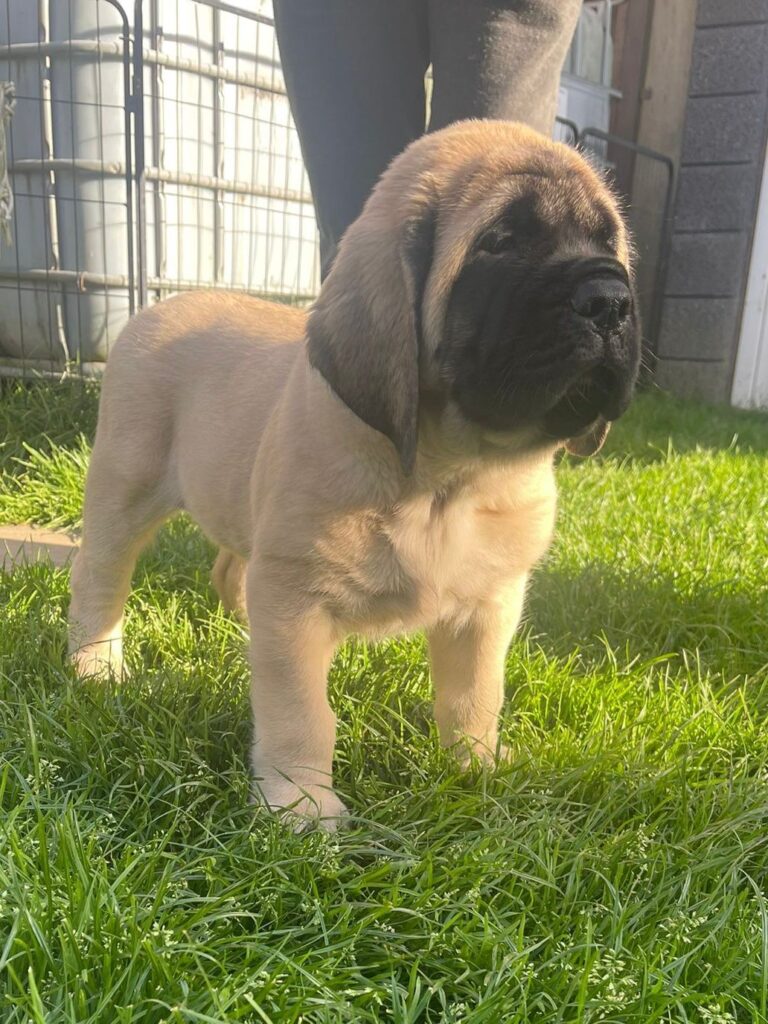
No stopwatch can replace watching your own puppy
Online, you will often find fixed rules stating that a puppy should only be walked for a certain number of minutes per month of age. At most, such guidelines can offer a rough indication. They do not take into account the surface, the weather, temperament, how the puppy feels that day or the intensity of the activity.
Ten minutes of relaxed sniffing in a meadow is very different from ten minutes of fast walking on asphalt. A calm walk in familiar surroundings places different demands on a puppy than a visit to a busy town centre full of sounds, people and smells.
We therefore pay less attention to the clock and more attention to the puppy:
- Is the puppy still moving freely and evenly?
- Is it still interested in its surroundings?
- Is it falling noticeably behind?
- Does it repeatedly sit or lie down?
- Does it seem content after the outing, or completely overstimulated?
- Does it get up and move normally after sleeping?
- Is it still keen to move the following day?
A puppy that sleeps contentedly after an outing and then gets up normally has probably coped well with the activity. If, on the other hand, it seems unusually exhausted, stiff or reluctant to move, it may have been too much.
Your own puppy usually gives you good signals – we humans simply have to notice them in time.
Self-directed movement is especially valuable
When exploring freely, puppies usually move in a very varied way. They take a few steps, stop, change direction, sniff and sometimes simply sit down in the grass.
These changes help develop balance, coordination and body awareness. The puppy can choose its own pace and stop moving as soon as it needs a break.
A prospective study involving four large dog breeds found an association in puppies up to three months of age between free exercise on soft, slightly uneven ground and a lower occurrence of hip dysplasia. Regular access to stairs, by contrast, was associated with a higher risk in the same study. The study shows associations and does not prove that any single activity alone determines whether a dog’s hips will be healthy or affected.
For us, this nevertheless reinforces an important principle:
A puppy benefits from natural, varied movement – not from the longest possible exercise programme.
Suitable places include a securely fenced garden, a quiet meadow or a soft woodland path. There, the puppy can explore at its own pace instead of having to complete a set distance.
We show more special moments from our puppies’ upbringing and their first explorations in our Puppy Gallery.
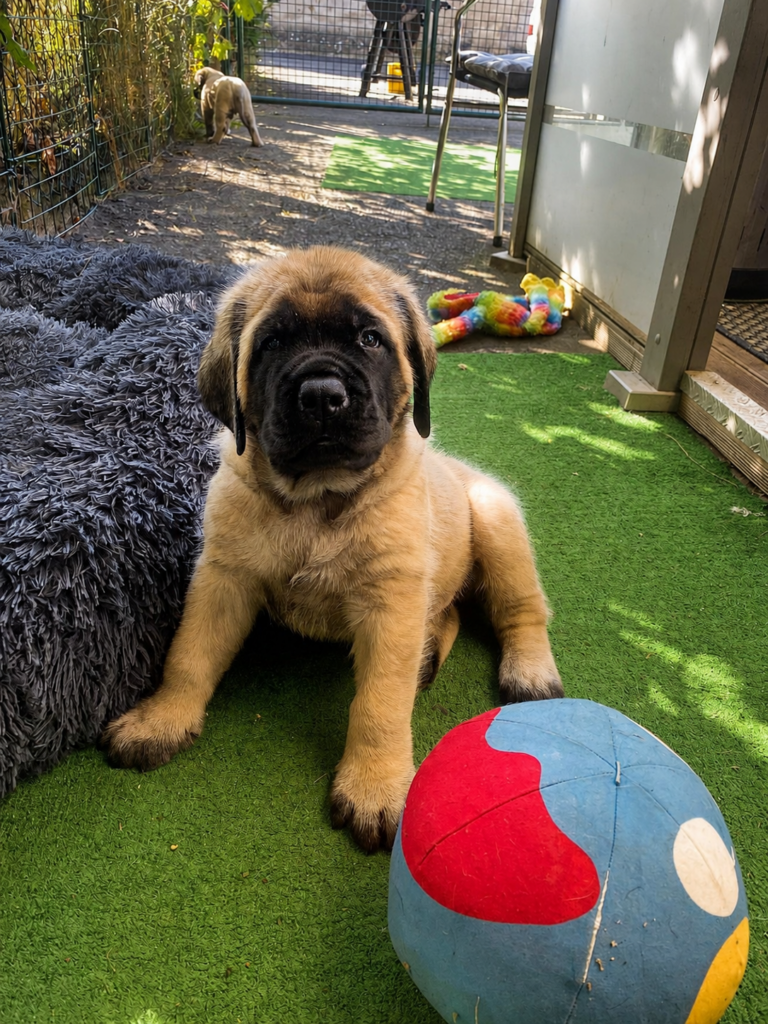
A walk is a journey of discovery
A walk with a Mastiff puppy does not need to be a sporting activity. Especially during the first few months, the aim is not to cover as much distance as possible.
Even a short outing can provide many valuable experiences: the puppy walks a few steps on a loose lead, watches a cyclist, hears an unfamiliar sound, sniffs a hedge and perhaps meets a friendly person.
For us, a good puppy walk is therefore more of a shared journey of discovery than simply travelling from A to B.
If the puppy stops, it does not need to be coaxed on immediately. It may be processing a new smell or watching something that seems completely ordinary to us.
Several short, relaxed outings are often more useful than one long walk. After a particularly exciting experience, the following day can deliberately be quieter.
Not every day needs to bring a new adventure.
Exercise and socialisation go hand in hand
During an outing, a puppy learns not only about its own body, but also about the world around it. The first three months of life in particular are considered an important period for positive experiences with people, animals, sounds and different environments.
The American Veterinary Society of Animal Behavior recommends that puppies be safely and carefully socialised even before the full vaccination series is complete. New experiences should not lead to severe fear, withdrawal or overwhelm. Heavily frequented areas with many dogs of unknown health status should be avoided.
For us, that does not mean a puppy has to go everywhere.
Often, it is enough to observe a new place from a safe distance. The puppy can take everything in calmly and decide for itself whether it wants to move closer.
What matters most to us is this:
It is not about having as many experiences as possible, but about having good experiences.
If a puppy shows uncertainty, we give it space and time. It does not have to endure a situation simply so that it can be ticked off a mental checklist.
We explain how our English Mastiff puppies grow up as part of everyday family life and become familiar with different people, dogs and everyday experiences on our page English Mastiff Puppies.
How exercise changes as a puppy grows
Every Mastiff puppy develops individually. That is why we do not want to prescribe rigid schedules. Nevertheless, a few general stages can be described.
After arriving in the new home
During the first few days in a new home, short trips outside for toileting and calm exploration of the immediate surroundings are enough.
The puppy is already processing separation from its littermates, new people, new sounds and a different daily routine. That is a major challenge in itself – even without a long walk.
During the first few months
The puppy becomes more curious, more confident and physically more skilful. Short walks, controlled play and experience on different surfaces can gradually be increased.
Sniffing, observing and taking short breaks are explicitly part of this. The puppy does not need to march continuously on a short lead at a predetermined pace.
During adolescence
A young Mastiff may already look impressively large and powerful. Its outward appearance can easily disguise the fact that its body is still not fully mature.
Large dogs may continue growing until around 18 months of age, and some giant breeds until roughly 24 months. The actual stage of development varies from dog to dog and should be assessed by a veterinarian before more intensive sporting activity is introduced.
For that reason, prolonged jogging, extensive hikes, running alongside a bicycle or dog sports involving a lot of jumping do not belong in the early growth phase in our view.
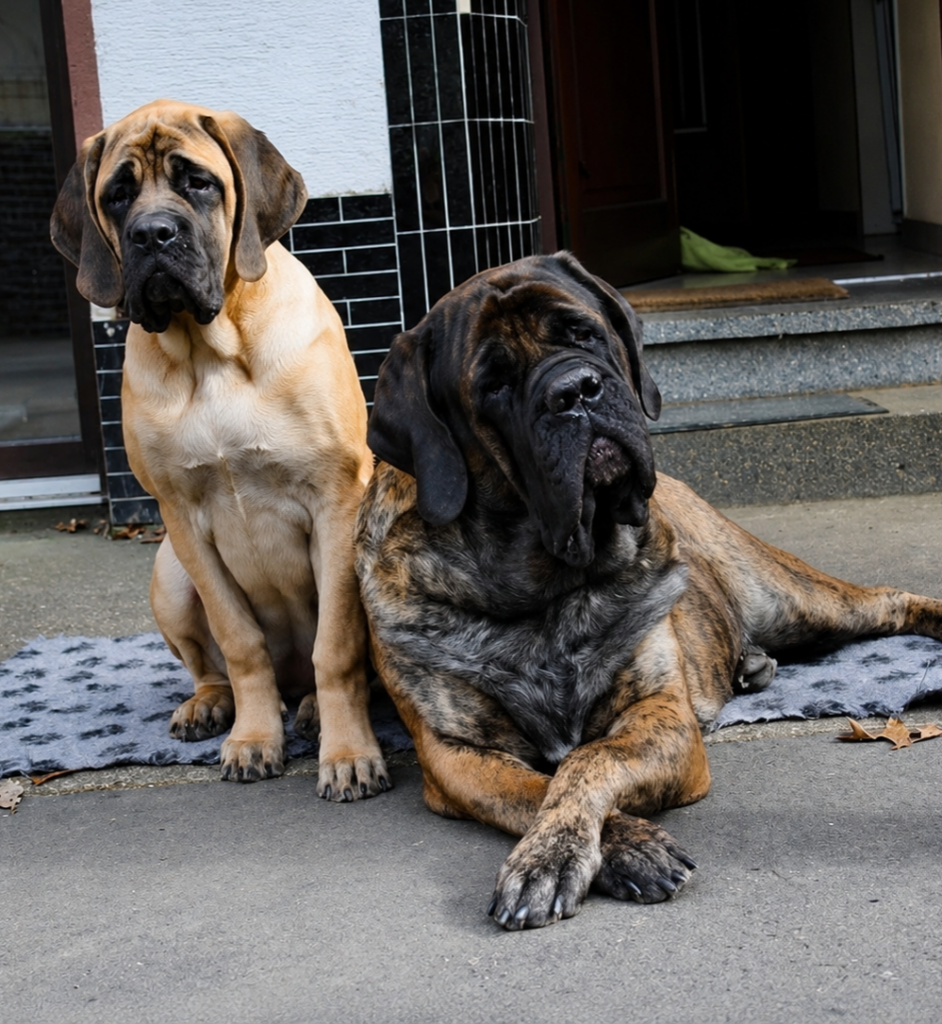
We introduce our adult English Mastiffs and their different personalities in more detail on our Mastiffs page.
Stairs, jumping and slippery floors
Stairs are a major concern for many puppy owners. A single low step is not comparable to running up and down several flights of stairs every day. Nevertheless, we would avoid regular stair climbing as far as possible during the first months of life. The study mentioned above found an unfavourable association particularly during the first three months in large-breed puppies.
As long as a Mastiff puppy can be carried safely, that is one option. Because this period does not last long with a Mastiff, it is worth finding a practical solution early on:
- stair gates to prevent unsupervised access,
- keeping necessary trips on stairs to a minimum,
- taking stairs slowly and in a controlled manner,
- and providing a non-slip surface.
We would also avoid repeated jumping out of the car or off furniture. When jumping down, a young dog has to absorb its weight abruptly through the front legs. A stable, non-slip car ramp can therefore be a useful solution.
One accidental jump is no reason to panic. What matters is that hard landings do not become a daily part of puppy life.
Tiles, laminate and smooth wooden floors can also make it harder for a puppy to stand up, turn and slow down safely. Washable runners or non-slip mats can provide better grip along frequently used routes through the home.
Playing with other dogs
Playing together can be wonderful and educational for puppies. They learn body language, consideration and social boundaries. At the same time, they develop coordination and body awareness.
But not every playmate is suitable for every puppy.
A friendly but very boisterous adult dog may repeatedly knock over a young Mastiff. Conversely, as a Mastiff puppy becomes heavier, it may also become too rough for a much smaller dog even though it means no harm.
We therefore observe not only whether the dogs are playing, but also how they interact with each other.
Good play includes short pauses and changes of role. Both dogs voluntarily seek contact again. One does not constantly chase the other, and neither tries to hide or escape from the situation.
We interrupt play if:
- a puppy is repeatedly knocked over,
- there are no longer any changes of role,
- one of the dogs is clearly trying to create distance,
- the movements become increasingly frantic,
- or the puppy is visibly tired.
A short break does not spoil the dogs’ fun. Often, it helps the play become calmer and more balanced again afterwards.
Not every toy has to be thrown
Many puppies love balls and moving toys. There is nothing wrong with that in principle, as long as play remains calm and controlled.
Constantly throwing a ball can become problematic. The dog accelerates, brakes abruptly, turns quickly and often continues chasing the ball beyond its actual point of fatigue.
We therefore prefer games in which the puppy can control its own movement to a greater extent:
- carrying a toy together,
- gentle tugging,
- searching for an object,
- finding individual pieces of food in the grass,
- or exploring a ball independently.
Play does not always need to become faster and more exciting. Calm games are often at least as valuable.
Rest is part of healthy exercise
Some puppies lie down when they are tired. Others suddenly become especially wild: they race around the room, bite at hands or clothing more often and struggle to settle despite being visibly exhausted.
This behaviour can easily be mistaken for a sign that the puppy needs even more activity. In our experience, the opposite is often true.
At that point, the puppy does not necessarily need another walk, but rather help settling down.
A quiet place to sleep, familiar routines and periods without constant attention can help. The AVSAB also recommends safe areas where puppies can sleep, withdraw and spend some time occupying themselves.
A puppy does not need to be entertained all day. It can observe, be bored for a while or simply sleep near its people.
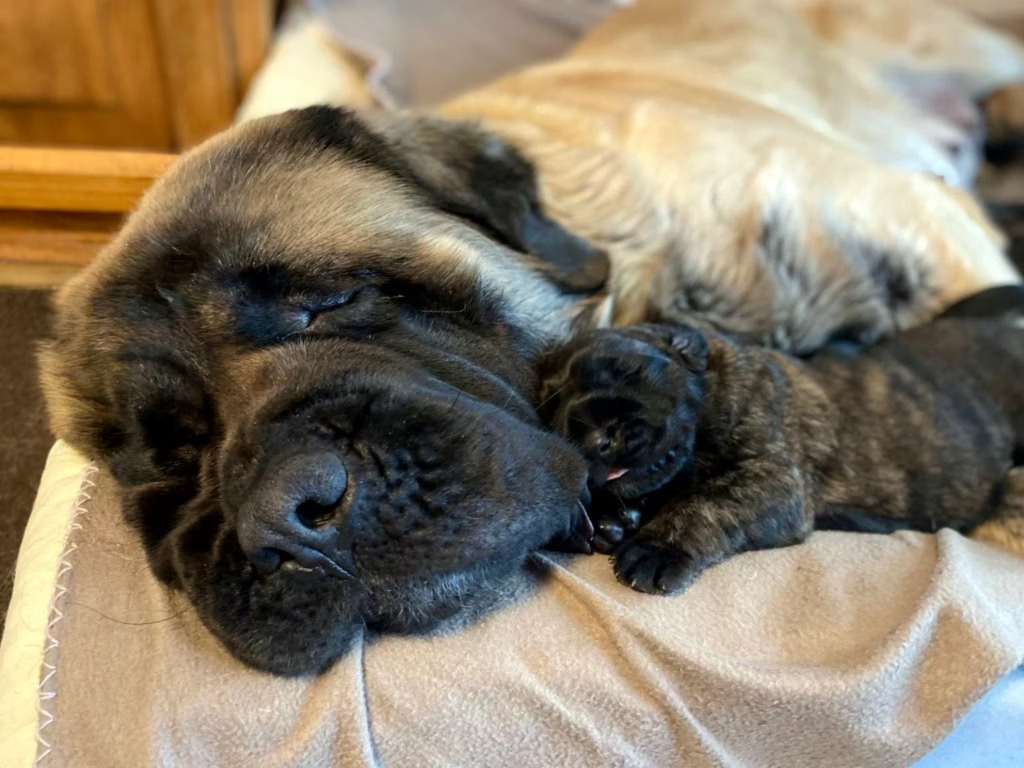
Body weight and exercise belong together
Healthy exercise cannot be considered entirely separately from nutrition and body weight.
A Mastiff puppy should grow slowly and evenly rather than putting on as much mass as possible as quickly as possible. Large and giant dogs that grow too fast or become too heavy carry additional weight on a musculoskeletal system that is not yet fully developed whenever they move.
We therefore look at more than just the number on the scales. Body structure, ribs, waist, muscle development and overall growth together provide a much more meaningful picture.
We explain in detail why slow, balanced growth is so important in our guide “Mastiff Puppy Growth”.
Exercise in warm weather
With a Mastiff, we need to pay particularly close attention to the weather. On warm days, we move outings to the cooler morning or evening hours whenever possible. In very hot weather, a walk can be much shorter or skipped altogether.
Research by the Royal Veterinary College has shown that exercise was the most common known trigger of heat-related illness in dogs. Many cases occurred during ordinary walks.
Warning signs can include:
- unusually heavy or persistent panting,
- laboured or noticeably noisy breathing,
- marked weakness,
- staggering or disorientation,
- vomiting,
- or collapse.
If overheating is suspected, activity should stop immediately, the dog should be cooled with cooler water and air movement, and veterinary advice should be sought without delay.
Missing one walk will not harm a puppy. Overheating, on the other hand, can be life-threatening.
How do we recognise possible overexertion?
Not every puppy stops in time on its own. Some keep going for longer than is good for them out of excitement or simply because they want to follow their people.
During and after exercise, we watch for:
- repeated sitting or lying down,
- falling noticeably behind,
- declining coordination,
- heavy panting,
- loss of interest in the surroundings,
- unusual exhaustion,
- stiffness after sleeping,
- or reluctance to move the following day.
Lameness, pain, swelling or a noticeable change in gait should be assessed by a veterinarian. Injuries to active growth plates can affect further bone growth in young dogs.
Not every brief period of tiredness is a cause for concern. Repeated or persistent problems, however, should not simply be dismissed as a normal growth spurt.
Increase activity gradually
A young Mastiff does not need to prove its endurance. Its capacity for exercise develops step by step – and the amount of activity should increase in the same way.
Whenever possible, we would change only one thing at a time:
- either make the walk a little longer,
- visit a new environment,
- or introduce a more challenging surface.
Not everything at once.
If a puppy visits a busy place for the first time, the outing does not also need to be particularly long. If it has attended a puppy group or had visitors, it does not need another major experience on the same day.
After increasing activity, we observe how the puppy moves that evening and the following day. If it remains loose, cheerful and balanced, it has probably coped well with the activity.
If it seems stiff, exhausted or unusually restless, the next day can be quieter again.
Reducing the level of activity is not a setback. For us, good guidance means responding to the puppy – not rigidly sticking to a plan.
What we would avoid during growth
With a young Mastiff, we would be particularly cautious about:
- long distances at a continuously imposed pace,
- jogging or running alongside a bicycle,
- frequent stair climbing,
- repeated jumping out of the car or off furniture,
- constant ball throwing involving abrupt braking and turning,
- wild play on slippery floors,
- exercise despite visible tiredness,
- and physical exertion in very warm weather.
That does not mean wrapping a puppy in cotton wool.
It can run. It can play. It can step over a small branch, experience different surfaces and sometimes still be a little clumsy.
Its everyday life simply should not consist of forms of exertion that it would never choose to sustain for long without us humans.
Our conclusion
A Mastiff puppy needs exercise. It needs it for its body, its development and its confidence in the world.
What it does not need is sporting goals or the expectation that it should already be able to cover long distances at a young age.
We want our puppies to be able to move naturally: to sniff, play, overcome small challenges and then settle down again.
The right amount cannot be measured solely in minutes or kilometres. It shows in a puppy that enjoys moving, moves freely and confidently, and is able to process its experiences well afterwards.
Sometimes a short walk is exactly right. Sometimes a play session in the garden is enough. And sometimes a quiet day together is the best decision.
Anyone who observes their Mastiff puppy carefully, respects its limits and increases activity gradually creates a valuable foundation for a long and active life together.
Do you have questions about raising, developing or living with a Mastiff puppy? You are very welcome to contact us personally.
Please note: This article combines our personal experience of raising puppies with general professional information. It is not a substitute for individual veterinary advice. If your puppy shows lameness, pain, an abnormal gait, or if you have questions about appropriate physical activity, please consult a veterinarian.