When a Mastiff puppy is born, their world is still very small. Warmth, milk, sleep and the familiar scents of the litter shape those first few days. Just a few weeks later, the helpless newborns have grown into curious little personalities who are becoming increasingly aware of the world around them.
For us, English Mastiff puppy socialisation does not begin with a rigid training programme. It begins with security, closeness and the confidence to explore new things at their own pace.
More than 30 years of living with Mastiffs have taught us that a puppy does not need to encounter as many different stimuli as possible. What matters is how they experience and process each situation. To us, good socialisation means carefully managed positive experiences, plenty of rest and close attention to each individual puppy.
Our English Mastiff puppies grow up at the heart of our family life and in close contact with our adult dogs. Step by step, this lays the foundation for a well-balanced Mastiff who will later be able to look to their family for guidance.
English Mastiff Puppy Socialisation Begins with Security and Trust
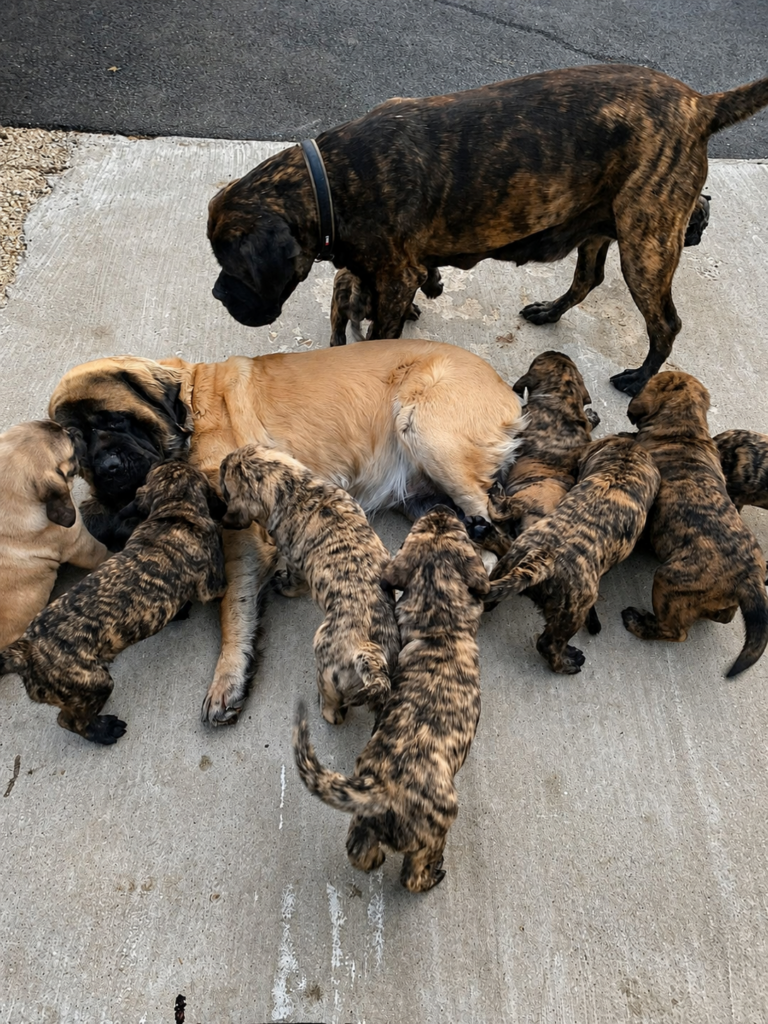
The mother plays the most important role in early socialisation. She provides her puppies not only with warmth, nourishment and security. Through her body language, her reactions and her closeness, she teaches them from the very beginning how dogs communicate with one another.
Through her, the puppies learn to recognise boundaries, to hold back and to settle down again after an exciting situation. They discover when closeness is welcome and when another dog needs space. Even the most thoughtful human guidance cannot replace these experiences.
Our first responsibility is therefore to provide the mother with a protected and peaceful environment. We observe this early stage closely, support her and intervene only when necessary. This allows her to guide her puppies safely and as naturally as possible.
At the same time, the puppies are gently introduced to human contact. They hear our voices, are carefully picked up during their daily checks and experience calm, gentle touch. Alongside their bond with their mother, their trust in people gradually begins to grow.
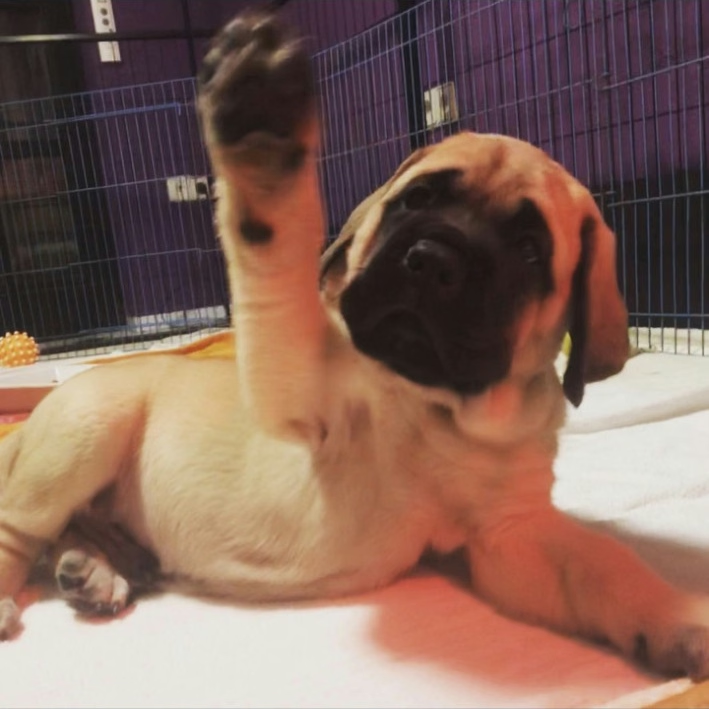
Everyday Life, Not Constant Stimulation
As soon as their eyes and ears open and their little paws become steadier, their curiosity grows too. The puppies become more aware of voices and movement, begin to play with one another and gradually expand the area they know.
Our ordinary daily life provides many valuable experiences. Dishes clatter, a door closes, the vacuum cleaner runs and a car passes outside. Carpet feels different from tiles, and grass feels different from the floor of the whelping area. New objects, small thresholds or a short journey can all become opportunities for discovery.
We do not expose the puppies to as many impressions as possible all at once. Instead, we observe how each puppy responds. Some immediately move forwards with curiosity, while others pause, watch and approach later. Both responses are perfectly fine.
A cautious puppy does not become more confident by being pushed into a situation. They are allowed to keep their distance, observe and take the next step for themselves. Likewise, a particularly curious puppy does not need an even bigger programme every day. What matters is not the number of experiences, but whether the puppy can process them positively.
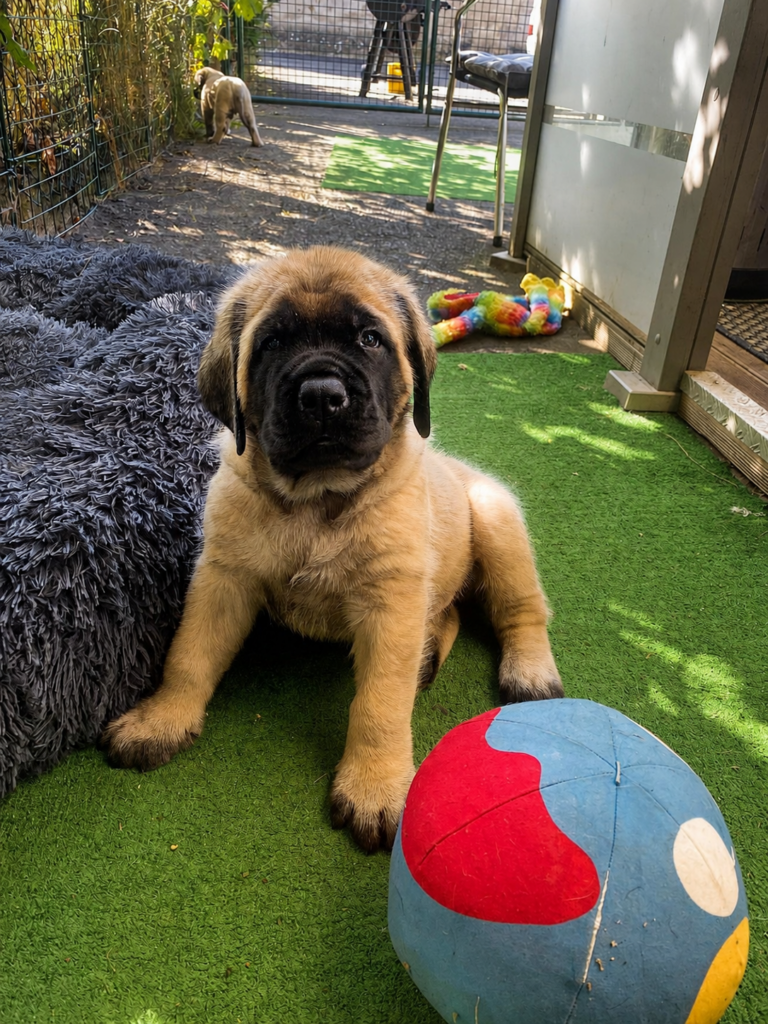
Learning with Littermates and Adult Mastiffs
After their mother, the puppies’ littermates also play an important role in their social development. By sleeping, playing and tumbling together, the puppies learn to recognise the reactions of other dogs. They share close contact, pull at the same toy and discover that another puppy does not always want exactly what they want at that moment.
Through playing together, they experience body language, reactions and their first boundaries. We observe these situations carefully, but we do not need to resolve every small disagreement for them. That, too, is part of growing up.
Later, carefully managed encounters with suitable adult Mastiffs are gradually introduced. An adult dog communicates differently from a littermate of the same age. They may radiate calm, set a clear boundary or simply allow a curious puppy to lie beside them.
Not every dog in our pack takes on the same role. Our Mastiffs have different personalities. We therefore decide carefully which encounter is suitable for the individual puppy and the adult dog. Here too, socialisation does not mean forcing contact, but creating safe and valuable experiences.
Touch, Body Awareness and Rest
In a comparatively short period of time, a small Mastiff puppy grows into a very large and powerful dog. That is why becoming comfortable with human handling should be part of their development from the very beginning.
We gently touch their paws, look at their ears and mouths and incorporate small checks into calm everyday moments. The puppy should not be restrained or forced into anything. They should learn that touch, grooming and future examinations are nothing to be worried about.
Different surfaces and small obstacles that the puppies choose to explore also help develop body awareness and coordination. The same principle applies here as it does to age-appropriate exercise for a Mastiff puppy: exploration, yes; physical performance, no. With such a large breed, we take particular care not to place excessive demands on physical development. We explain more in our article about Mastiff puppy growth.
The rest that follows is at least as important as every new experience. Puppies sleep a great deal, and this is when they process what they have experienced. That is why something new does not have to happen every day. After an exciting moment, the remainder of the day can be entirely uneventful.

Every Puppy Has Their Own Personality
Clear differences become apparent early on, even within the same litter. One puppy may immediately be at the front when something new appears, while another prefers to observe from a safe distance at first. To us, neither response is right or wrong.
We do not want to force our puppies into a fixed mould; we want to get to know them. How curious is each puppy? When do they look for support? How quickly do they settle again after excitement? These observations help us not only to support their development, but also to choose the right home for them.
Not every puppy is automatically suited to every family. Daily life, expectations and personality should be as well matched as possible. Personal contact with the puppies’ future families is therefore just as much a part of responsible rearing for us as health, care and socialisation.
A Foundation for Later Life
No breeder can introduce a puppy to every situation they will encounter later in life. Nor is that our aim. When one of our puppies leaves us, they are not a finished dog – and they should not be.
We want to give every puppy a stable foundation: trust in people, initial experience of family life, secure communication with other dogs and the ability to settle again after new impressions. They should be free to be curious without constantly having to perform, and learn that their family will provide guidance.
After the puppy leaves us, their new family continues along this path. We remain available to offer guidance, because to us, our responsibility does not end at the front door.
You can find more impressions from the first few weeks of life in our puppy gallery. We publish information about future litters in our current litter plans.
Ultimately, what matters to us is not that a puppy has experienced as much as possible. What matters is that they have been allowed to gain experiences that make them stronger – and that they join people who will be the right fit for them in the long term.