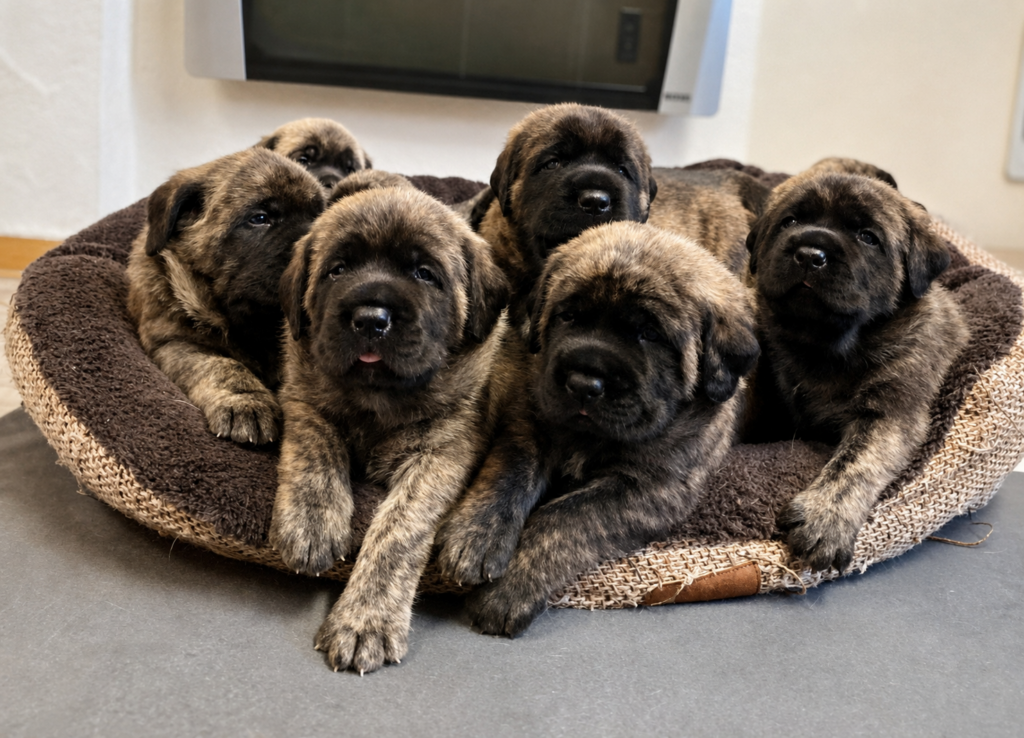
When a puppy leaves us, a wonderful new chapter begins for their family. At the same time, almost their entire world changes from one moment to the next. Until then, there were their mother, their siblings, familiar scents and familiar routines. Suddenly, they travel to an unfamiliar place and are expected to understand that this is now their home.
That is exactly why we believe the first few days should not be about giving a puppy as many experiences as possible. Above all, they should be about giving them time to arrive and settle in.
A Mastiff puppy does not have to prove anything during those first days. They do not need to walk perfectly on a lead, greet visitors correctly or complete as many exercises as possible. For them, the new home itself is already a great adventure.
The First Day Can Be Quiet
The excitement of bringing home a puppy is enormous. Family and friends often want to meet the new arrival as quickly as possible. Even so, we would recommend keeping the first day deliberately calm.
At first, the puppy can simply begin to discover their new home. Where is their sleeping place? Where do they go outside? Which people are now part of their everyday life?
Some puppies curiously explore every room. Others stay close to their new people at first or fall asleep after only a short time. Both are completely fine.
There is no reason to constantly encourage a cautious puppy to explore. Equally, a curious puppy does not need to discover the entire house, garden and neighbourhood straight away. They are allowed to show how much they are ready to take in.

Closeness Creates Security
A puppy who has just left their mother and siblings will often seek a great deal of closeness. To us, this is not something that needs to be discouraged. The puppy is simply finding their bearings.
Our Mastiffs live closely with us and are genuine family dogs. That is why we believe it is important to show a young dog from the very beginning that their people are reliable.
That does not mean the puppy has to be entertained around the clock. Often, it is quite enough for them to lie nearby, observe what is happening and sleep.
A permanent resting place can help. It should not be right in the middle of a busy walkway, but ideally somewhere that still allows the puppy to be part of family life.
The First Night Does Not Have to Be Perfect
The first night is something many future puppy owners think about long before their puppy arrives. Will the puppy sleep? Will they cry? Where should they sleep?
We do not believe much in rigid rules that are supposed to work in exactly the same way for every puppy.
For a young dog, the first night is an enormous change. For the first time, the familiar bodies and sounds of the litter are missing. There is nothing wrong with giving the puppy security during this transition. A sleeping place close to their people can make the change easier.
Every family can decide for themselves what the long-term sleeping arrangements should look like. What matters most is that the rules remain understandable and consistent.
Closeness can also be given without allowing something that will not be wanted later – through a calm voice, a hand beside the puppy’s bed or simply by being present in the same room.
A Simple Routine Helps
During the first few days, a puppy does not need a timetable planned down to the minute. Repeating certain routines, however, can help them find their bearings.
After sleeping, they go outside. After an exciting period, there is time to rest again. Small discoveries alternate with longer periods of sleep. Little by little, a rhythm develops that the puppy can understand.
When it comes to house training in particular, patience is far more important than perfection. A young dog first has to learn where they are supposed to relieve themselves. Accidents are part of the process and are not an act of disobedience.
We would therefore rather take a puppy outside calmly one time too many than correct them for something they cannot yet be expected to understand.
Less Activity, More Observation
Especially during those first few days, new owners can quickly worry that their puppy is not experiencing enough. What is often underestimated is just how demanding a new home already is for a young dog.
New rooms, different voices, unfamiliar smells, traffic noises, household appliances and an entirely new daily routine already provide plenty of impressions to process.
That is why we would wait with bigger outings until the puppy has clearly become a little more secure in their new home.
The first little trips outside can be short. A few minutes in front of the house can be far more exciting for a young dog than an entire walk might seem to us.
If the puppy sleeps deeply afterwards, that does not mean they need even more experiences the following day. Rest is an important part of their development.
A Mastiff grows into a very large dog remarkably quickly. Nevertheless, they remain a young dog for a long time. That is precisely why we believe it is worth bringing calmness rather than speed into everyday life from the very beginning. You can read more about this in our guide “Mastiff Puppy and Exercise – How Much Is Healthy?”.

Rules Can Be Kind and Clear
A small Mastiff puppy is incredibly cute. Some things seem harmless at this age that can look very different once the same dog has grown into an adult Mastiff.
That is why we like to think early about which rules should still apply later. Is the dog allowed on the sofa? How should they greet visitors? Are they allowed to jump up at people? Where is their resting place?
This is not about treating a puppy harshly. Clear rules simply make life easier for a dog to understand.
If something is enthusiastically allowed today and suddenly forbidden tomorrow, a puppy can hardly know what is expected of them.
Kindness and consistency are not opposites. For us, they belong together.
Especially with a breed that will later become very large and powerful, good training ultimately creates more freedom.
Visitors Can Wait
Of course, many people will want to meet the new puppy. Even so, during the first few days we would much rather allow a few calm encounters than have a constantly busy house.
The puppy does not need to be picked up or played with by every visitor. They can be allowed to approach people themselves and to withdraw whenever they need to.
Children should also learn from the beginning to respect the puppy’s sleeping place. A sleeping dog does not need to be stroked simply because they happen to look particularly adorable at that moment.
Trust Grows in Everyday Life
The bond between a dog and their people is not created through one single big experience. It develops through many small moments.
When the puppy realises at night that someone is there. When something outside startles them and they can look to their person for reassurance. When they are allowed to sleep undisturbed after an exciting experience. When rules are communicated calmly and do not change from one day to the next.
After a few days, the unfamiliar house slowly begins to feel like home. The puppy recognises the first routines and begins to understand their people better and better.
What still felt new and exciting on the first day gradually becomes part of everyday life.
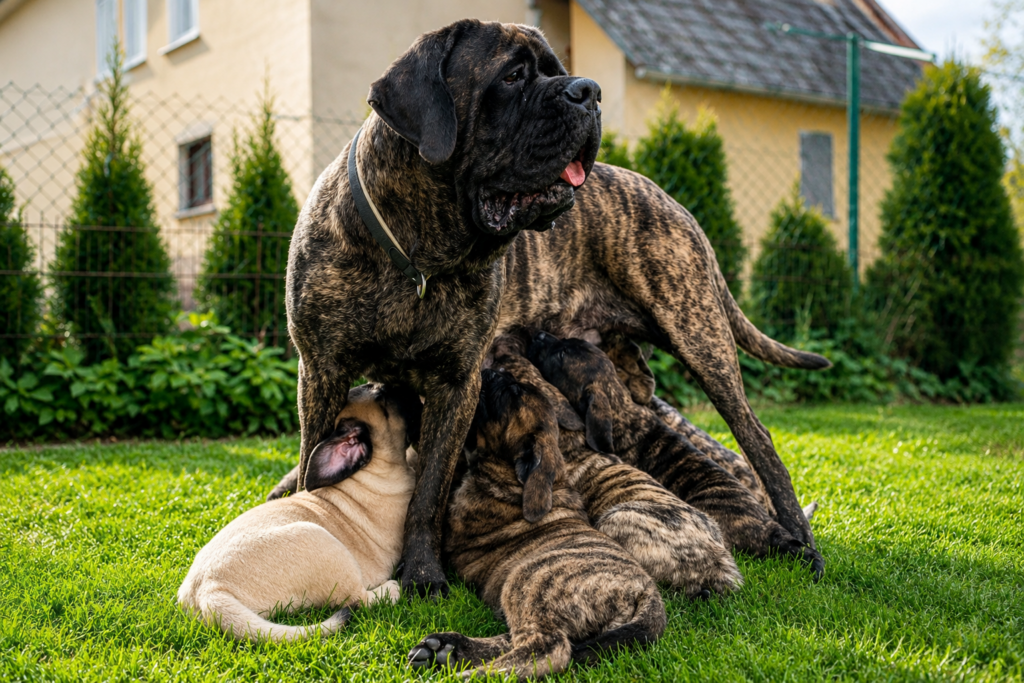
The foundation for this process, however, begins long before the puppy leaves us. The first weeks with their mother, siblings, people and the everyday impressions of family life help prepare them for their future home. We explain in more detail how we approach this important period in our article “From the Whelping Room to Family Life – How We Prepare Our Mastiff Puppies for Their Future Homes”.
Our Conclusion
Bringing home a Mastiff puppy does not have to be a perfectly planned event. What matters far more is a calm beginning with time, closeness, understandable rules and plenty of opportunities to sleep and observe.
For our puppies, we hope to find families who do not expect them to become a “finished dog” within their first few days.
A puppy is allowed to be curious, uncertain and tired. They are allowed to make mistakes and to learn step by step.
Anyone who gives their puppy security while also providing a reliable framework from the very beginning creates a wonderful foundation for their life together.
Because in the end, those first days are not about how much a puppy can already do.
They are about helping them begin to understand: I am safe here. This is where I belong.