Sometimes the wish for a Mastiff begins with a single image: that distinctive expression, the deep wrinkles, the enormous paws – and a presence that seems both impressive and incredibly gentle.
Perhaps you have already met a Mastiff. Perhaps you have been interested in the breed for some time. Or maybe you are looking for a large, calm family dog and increasingly find yourself thinking: This is exactly the kind of dog I would love to have by my side.
We understand that enthusiasm very well. To us, Mastiffs are far more than simply large dogs. They are loving family members, calm observers, loyal companions and unique personalities in their own right.
You can get to know the different personalities of our adult Mastiffs on our Mastiff page.
For us, however, the decision to share your life with a Mastiff does not begin on the day a puppy moves in. It begins much earlier – with an honest and at the same time wonderful question:
Is a Mastiff really right for my life?
The Mastiff is known as a large, powerful and dignified dog with a calm and affectionate nature towards its people. It is precisely this combination of gentleness, composure and physical strength that makes the breed so special to us.
Our 7-day real-life test is not intended to examine anyone or take away the excitement of a future puppy. Quite the opposite: we want to help prospective owners imagine life together as honestly, realistically and positively as possible before the puppy arrives.
The aim is not to finish the week with a perfect tick in every box. It is about recognising what already fits well, what still needs to be prepared and which questions can be discussed personally with an experienced breeder.
Why a Real-Life Test Instead of a Standard Checklist?
Many guides ask whether there is enough time, space and money for a dog. These are important questions, but they often remain very theoretical.
Almost anyone can immediately say:
“Of course I have time for a dog.”
The more interesting question is what that time looks like on an ordinary Tuesday morning – when it is raining, the night was short and the working day starts earlier than planned.
That is exactly why our test lasts seven days. A whole week usually contains much more of real life than a quick mental checklist: working days, appointments, shopping, perhaps visitors – and moments when things do not go according to plan.
Take a little time each day and look at your home and daily routine as though a Mastiff already lived there. Do not think only about puppyhood. Deliberately imagine the adult dog that this small puppy will eventually become.
For us, the right decision is not based solely on being fascinated by the appearance of a breed. It is made where temperament, living situation, time, everyday life and long-term responsibility truly fit together.
Day 1: A Home That Can Grow with the Puppy
On the first day, we look at our home with a different perspective.
A Mastiff puppy may still look small among its blankets and toys at first. Yet those adorable paws will become part of a large and powerful dog within a comparatively short time. The future living space therefore needs to suit not only the puppy, but also the adult Mastiff.
No one needs to own an enormous house. What matters far more is that the dog has a permanent, peaceful place of its own and can move around safely in everyday life.
Walk consciously through your flat or house:
Where could a sufficiently large dog bed be placed without being directly in a constantly used walkway? Is there somewhere the dog can be part of family life while still being able to retreat and rest? Are frequently used floors very slippery? Are there stairs that a puppy should initially not use unsupervised?
Also think about the little things that suddenly take on a different meaning when you live with a very large dog.
A low coffee table can quickly end up at nose height. A powerful tail can move more than you might expect when the dog is happily wagging it. Bowls, blankets, toys and grooming equipment also need their own places.
For us, a Mastiff-friendly home does not mean that everything has to be perfect or particularly large. It means something much simpler:
The dog is considered a full member of the family from the very beginning.
Our Small Task for Day 1
Place a large blanket or several cushions where you think the future dog bed could go.
Leave them there for the entire day. Does the space really work in everyday life, or is it constantly in the way? Could the dog sleep peacefully there while still being close to its people?
This small experiment often makes the future size of a Mastiff easier to imagine than measurements alone.
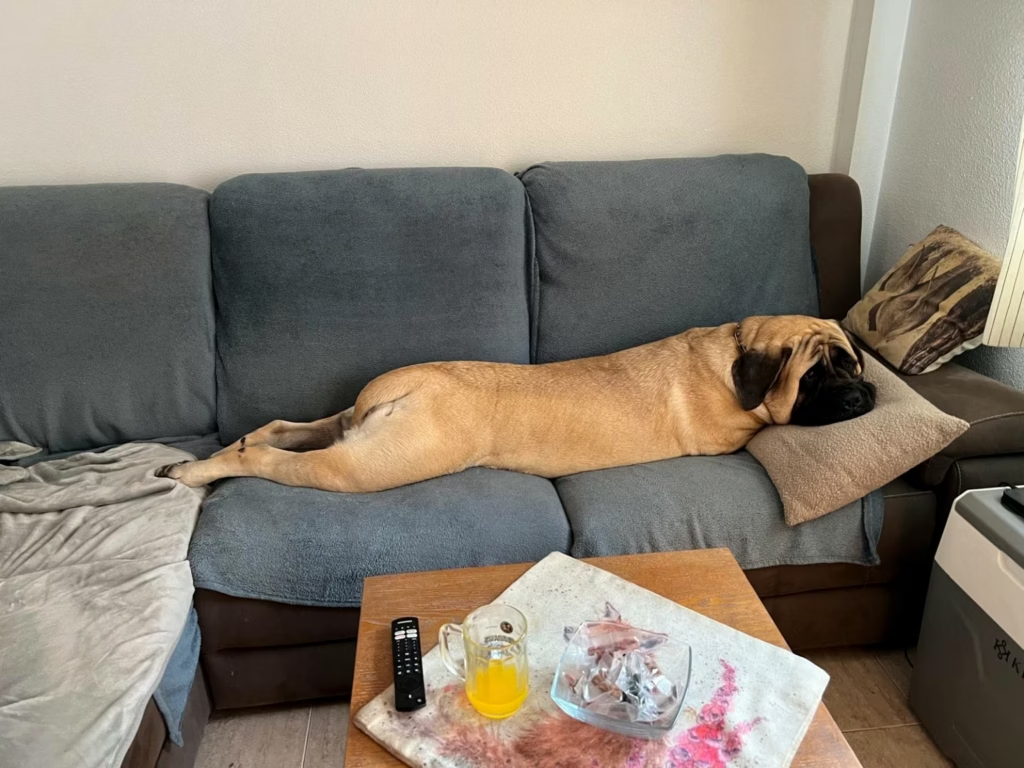
You can find more impressions from the first weeks of our puppies’ lives and their everyday family life in our Puppy Gallery.
Day 2: How Much Time Do We Really Have?
On the second day, the aim is not to add up as many free hours as possible. It is about when that time is available and what form it takes.
At first, a puppy needs many short opportunities to go outside to relieve itself. It needs rest, closeness, patient training and people who introduce it to everyday life step by step. This rhythm changes later, but an adult Mastiff still needs reliable time together with its family.
Not every minute together has to involve an activity. Mastiffs can be wonderful, calm companions. They often enjoy simply lying near their people and being part of family life.
Even so, a dog does not organise its own day.
Who takes the dog outside in the morning? What happens on long working days? Who takes over if someone is ill, has to leave for work earlier than expected or an appointment is unexpectedly moved? Are there responsibilities that should be clearly divided within the family?
Today, do not look at a relaxed Sunday. Look at your busiest normal weekday.
Imagine this: the puppy needs to go outside while breakfast is being prepared. There is an appointment in the afternoon. In the evening it is raining, and everyone would really rather just sit on the sofa.
Does the idea still feel manageable?
It does not have to feel convenient at all times. Living with a dog requires organisation. What matters is that the responsibility fits into everyday life not only when everything goes according to plan.
Our Small Task for Day 2
Plan the next day as a trial run, as though the dog were already there.
When would the first short outing take place? Who would have time around midday? When would there be a shared period of rest? What would the evening look like?
This trial plan does not have to be perfect. But it often shows very quickly where good solutions are already in place and where additional support may still need to be organised.
Day 3: The Little XXL Logistics Day
A Mastiff may be a lap dog at heart – physically, however, it remains a very large dog.
On the third day, we therefore think about the practical side of everyday life together. Not to look for problems, but to make future outings and shared experiences as straightforward as possible.
Take a look at your car:
Is there a safe place for a fully grown Mastiff? Can the dog get in and out comfortably? Would a ramp be useful later? Would there still be enough room for luggage on a holiday journey?
The journey to the veterinary practice is also part of the planning. Which practice in your area is well equipped to treat a very large dog? How would transport work if the dog were ever unable to get into the car independently?
A Mastiff puppy can still be carried at first. With an adult dog, that is normally no longer a realistic solution. It is therefore reassuring to think through these situations before they unexpectedly arise.
Even ordinary shopping changes a little. Food, large beds, suitable collars, strong leads and sufficiently large transport solutions all need to match the size of the dog.
We like to call this the XXL logistics day – but behind it is a very positive idea:
We prepare our everyday life so that our dog can take part in it as naturally as possible.
Our Small Task for Day 3
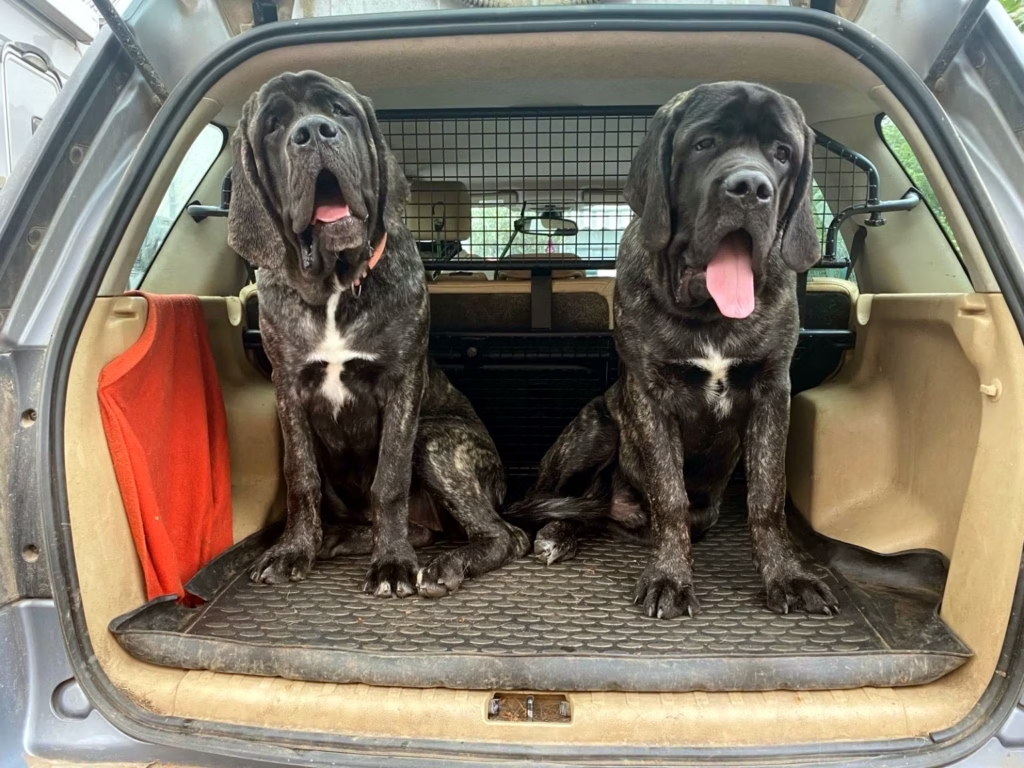
Open the boot of your car and imagine a fully grown Mastiff inside it.
Would the space be safe and comfortable? Would anything need to be modified or organised differently? Would there still be enough room for longer journeys?
Then check which veterinary practice and which trusted person would be easy to reach if you ever needed help.
Day 4: What Does Life Together Cost – Not Just the Puppy?
Day four is about money – but not in the form of a frightening list of expenses.
A puppy has a purchase price. Life together, however, involves many other regular and occasional costs. These may include food, equipment, dog tax, insurance, preventive care, veterinary treatment, possible dog care and shared activities.
With a very large dog, some products and services naturally cost more than they would for a small dog.
This does not mean that someone has to be wealthy to own a Mastiff. It simply means that ongoing costs should be considered honestly as part of family planning.
It is not only an ordinary month that matters. Unexpected expenses should also be manageable without every necessary veterinary decision immediately becoming a financial crisis.
Insurance or a savings account that is regularly built up for the dog can provide additional security. Which solution fits best depends on the individual situation.
Our Small Task for Day 4
Today, put aside the amount you expect to budget for the dog each month.
Do not only ask yourself:
“Can I afford this this month?”
Instead ask:
Could this amount permanently become part of our normal life – even in a month with a holiday, repairs or other expenses?
This small exercise is often more useful than a general cost table because every family has different circumstances and priorities.
Day 5: What Rules Should Apply in Our Home?
On the fifth day, things become personal – and sometimes a little amusing.
Will the Mastiff be allowed on the sofa? Will it be allowed in the bedroom? Where will it be fed? How should it greet visitors? Who decides which rules apply?
Some behaviours can still seem cute in a small puppy. When the same dog is later large and powerful, the situation can look very different.
That is why we believe the fairest rules are those that are understandable from the beginning and can realistically be maintained in the long term.
This does not mean that a Mastiff needs to live in a strict household. Quite the opposite: kindness, patience and a relationship based on trust are the foundation of training for us.
But kind training still needs clarity.
If one person enthusiastically encourages the puppy to jump up while another forbids it, the puppy can hardly understand what is expected. The same applies to begging at the table, pulling on the lead or interacting with visitors.
With a large dog in particular, good training creates a great deal of freedom later on.
A Mastiff that walks calmly on the lead, responds reliably to its people and looks to them for guidance can take part in everyday life much more easily and calmly.
Our Small Task for Day 5
Sit down with everyone who will regularly share the home with the dog.
Start by agreeing on five simple house rules:
- Is the dog allowed on the sofa?
- Will it receive food from the table?
- How should it greet visitors?
- Where will its sleeping place be?
- Which words will be used for important cues?
The aim is not to write a complete training plan today. Even a few shared rules create a good foundation.
Day 6: Does a Mastiff Fit into Our Imperfect Life Too?
At first, we all tend to imagine life with a dog through particularly beautiful images:
Walks together in pleasant weather, a peacefully sleeping puppy, outings, holidays and cosy evenings on the sofa.
Those moments will happen – and they are wonderful.
But real life is not made up exclusively of days like these.
There will be rain, illness, stress at work, family celebrations and situations in which we are tired or impatient. The dog is still part of the day.
On day six, we therefore do not ask whether a Mastiff fits into our ideal life, but:
Does a Mastiff fit into our real life too?
Who looks after the dog if we are ill in bed? Who could take over if we unexpectedly need help for several days? Is there someone who feels comfortable handling such a large dog?
What about holidays? Can the dog come along, or is there suitable and familiar care available? Are spontaneous weekends away still possible – perhaps simply with a little more planning?
Being left alone is also part of real life. A puppy does not automatically know how to cope with this and has to learn it gradually and carefully. At the same time, family life should be organised so that the dog does not regularly have to stay alone longer than it can reasonably manage.
An unanswered question does not mean that a Mastiff is not right for you. It simply shows where a solution should be found before the puppy arrives.
Our Small Task for Day 6
Choose the most difficult day of your past week.
Perhaps there was overtime, a medical appointment, illness, visitors or an unexpected journey.
Now imagine that the Mastiff had already been part of that day. Where would things have worked well? Where would help have been needed? Who could have provided that help?
This thought experiment often shows very honestly how resilient your current planning already is.
Day 7: What Do We Really Want from Life with Our Mastiff?
On the final day, it is no longer about the size of the dog bed, the car boot or daily schedules. It is about the relationship we hope to have.
Why do we want a Mastiff in particular?
Is it the breed’s calm presence? Its closeness to its people? Its impressive appearance? The wish for a loving family companion? An interest in dog shows? Or enthusiasm for the history and special characteristics of the breed?
There is no single correct answer.
What matters is that we do not fall in love only with the image of a Mastiff, but also with the life that comes with one.
A Mastiff will not pose majestically for a beautiful photograph every day. Sometimes it will lie in the way, drool, leave a mark on freshly washed trousers and be completely convinced that the exact place where you want to walk is the perfect place to settle down.
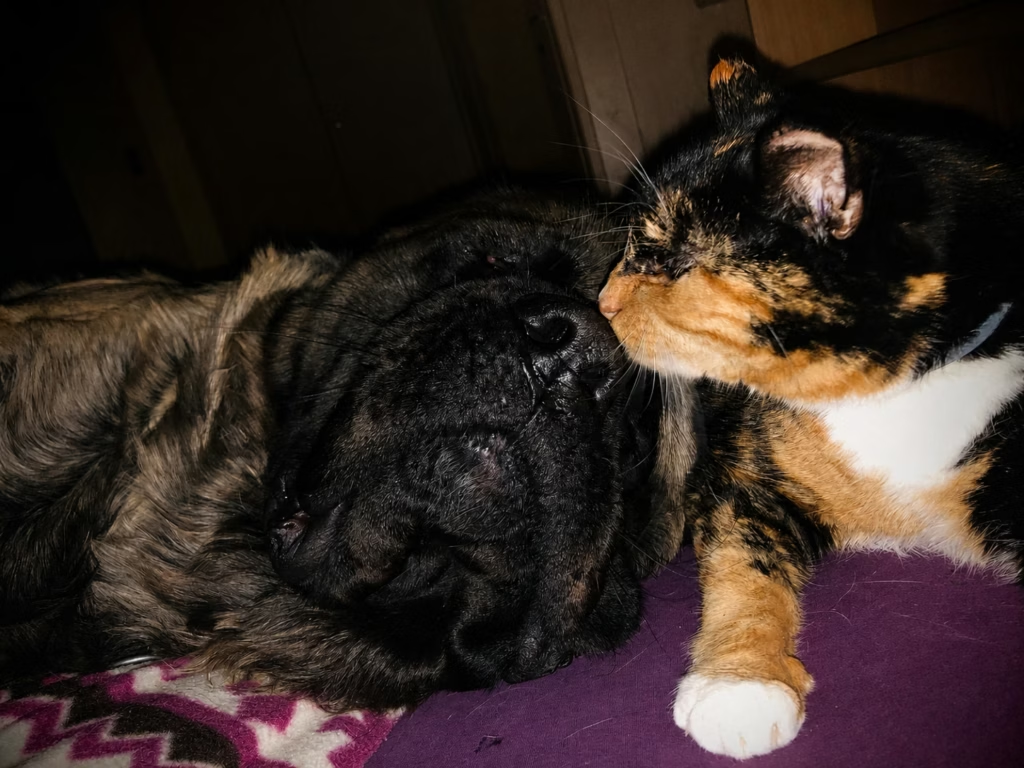
At the same time, a Mastiff can give us a sense of calm, loyalty and affection that is difficult to put into words.
Behind its imposing appearance should not be an uncontrollable dog, but a balanced, secure companion that is guided with kindness and consistency.
For us, the decisive question is therefore not:
“Is a Mastiff the most impressive dog for me?”
But rather:
Do I want to remain a reliable person for this dog even when the little puppy has long since grown into an adult?
Our Small Task for Day 7
Write down three things you are especially looking forward to about life with a Mastiff.
Then write down three questions you are still unsure about.
Your excitement is absolutely allowed to outweigh the uncertainties. Open questions are not a bad sign. They show that you are taking the decision seriously – and that is exactly where a responsible breeder can help.
You can learn more about our many years of experience, our breeding philosophy and how our puppies are raised at From the Celtic Mountain on our About Us page.
The Result: This Is Not About Passing or Failing
Our real-life test deliberately does not end with a score.
Someone may have a large garden and still have very little time for their dog. Another family may not have a large garden or may live in a smaller home, yet organise everyday life with such care and reliability that the dog is wonderfully well looked after there.
That is why we prefer to think of the seven days as a simple traffic-light system:
Green means: This already feels realistic and comfortable.
Amber means: We still need a solution, an item of equipment or a conversation here.
Red does not automatically mean that a Mastiff can never become part of your family. Perhaps the timing is simply not right yet.
An honest “not yet” can be a very responsible decision.
And sometimes, after good preparation, it becomes a confident:
Now we are ready.
Questions Future Owners Can Ask a Breeder
A good conversation does not begin only once a particular puppy has been chosen.
Future owners are welcome to ask many questions – and should be equally open about their everyday life, expectations and living situation.
Useful questions include:
- How would you describe the typical temperament of your dogs?
- How are the puppies raised in your home?
- Which people, animals, sounds and everyday situations are they already familiar with?
- Which puppy might suit our family best in terms of temperament?
- How should we organise the first few days after the puppy comes home?
- What food is the puppy already familiar with?
- What equipment will the puppy need at the beginning?
- Will you remain available as a contact after the puppy has moved to its new home?
We explain in detail how our English Mastiff puppies are raised, how they are prepared for their future homes and what they take with them when they leave us on our Puppies & Litter Plans page.
For us, choosing a puppy is not simply a decision based on colour, sex or the first photograph.
Every puppy already brings its own little personality. Some prefer to observe calmly at first, while others are immediately at the front of the queue for every new adventure. That is why conversations about expectations, living situation and temperament are so important.
Not every puppy is right for every family – but for the right puppy, that family can become the most wonderful home.
Our Conclusion
The decision to welcome a Mastiff into your life is allowed to begin with enthusiasm. It can be emotional, full of anticipation and perhaps even a long-held wish from the heart.
Responsibility does not mean replacing those feelings with cold, clinical checklists.
Responsibility means combining that excitement with good preparation.
Our 7-day real-life test is therefore not intended to be a hurdle. It is designed to help future owners invite the Mastiff into their lives in a small way even before the puppy actually arrives.
Perhaps after this week you will discover that many things already fit wonderfully well. Perhaps you will identify a few points that still need preparation. Both outcomes are valuable.
A Mastiff does not need a spectacular programme every day. It needs closeness, reliability, loving guidance and people who genuinely want it to be part of their everyday lives.
Anyone who is ready to make room not only for a puppy, but also for the adult dog and all the years that will follow, is creating a wonderful foundation.
Because in the end, a Mastiff should not merely fit into our home.
It should fit into our life – and have a permanent place there for the rest of its life.
Have you completed the real-life test and would like to take the next step? You can find information about our planned English Mastiff litter planned for early 2027 in our current litter announcement.
If you have questions about our dogs, how we raise our puppies or a future puppy, you are very welcome to contact us personally. We look forward to getting to know you and hearing how you imagine life with a Mastiff.
Note: This article is intended to help future owners make a personal and realistic decision. Every dog and every living situation is individual. We therefore recommend discussing open questions early with the breeder, a qualified dog trainer and, for questions relating to health or care, a veterinarian.